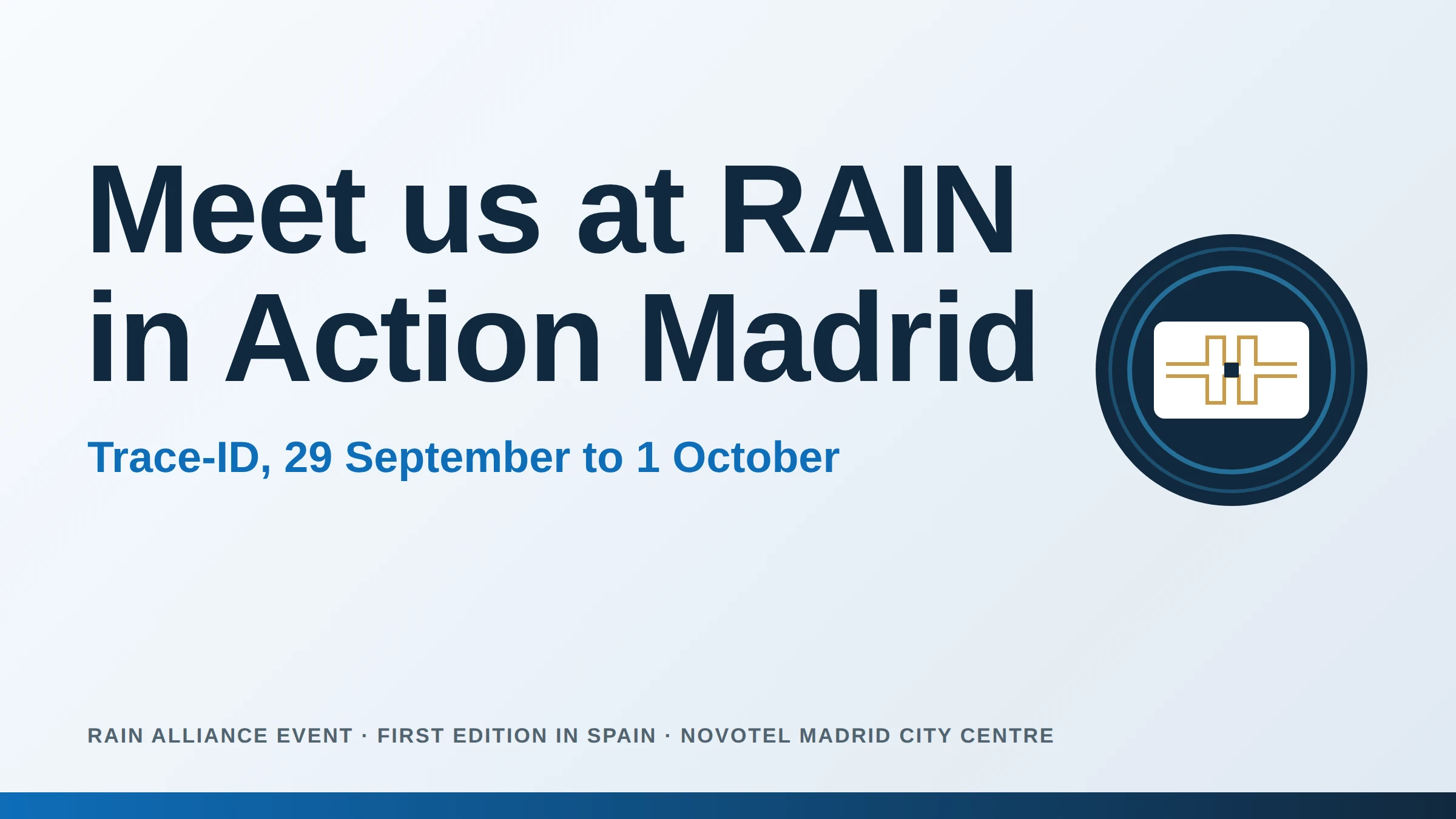
For years, to hear first-hand how major retail chains deploy RAIN RFID, you had to fly to Amsterdam, the United States or wherever the event was held that year. Not this time. RAIN in Action 2026, the RAIN Alliance’s international conference, is taking place in Madrid from 29 September to 1 October, and is the first edition to be held in Spain.
We’ll be there with our own meeting space and part of the team. For an RFID tag manufacturer with a factory in L’Hospitalet de Llobregat, having the RAIN community just a couple of hours away by train is an opportunity we have no intention of missing.
In this article, we’ll explain what RAIN in Action is, what topics will be on the agenda, why we believe RFID tags deserve a place in all these discussions, and how to book a meeting with us in Madrid.
What is RAIN in Action?
RAIN in Action is the annual event organised by the RAIN Alliance, the global association driving the adoption of RAIN RFID (passive UHF RFID based on the EPC Gen2 / ISO/IEC 18000-63 protocol). The 2026 edition takes place from 29 September to 1 October at the Novotel Madrid City Centre, featuring end-user case studies, live demonstrations and hands-on workshops.
This year’s theme is “From Infrastructure to Impact”: moving on from talking about readers, antennas and chips to discussing how that infrastructure changes operations. It is an event with a very specific focus. People don’t come here to find out what RFID is; they come to compare how others are using it at scale, what problems they’ve encountered and what comes next. The previous edition, in Amsterdam, was fully booked.
In addition to the conference sessions, the programme includes an extra day, by invitation only, featuring a visit to a demonstration centre where attendees can see solutions in action under real-world conditions.
Why it matters that it is being held in Madrid
The RAIN Alliance itself has explained the choice of Madrid as reflecting Spain’s growing influence within the European RAIN RFID ecosystem, particularly in retail and logistics. Anyone who has followed the sector in recent years will understand this: Spain is home to some of the fashion groups that were among the first – and on the largest scale – to adopt RFID tagging at item level, and a network of integrators, converters and manufacturers has formed around them.
The global context is favourable. According to the RAIN Alliance, 42,700 million chips for RAIN RFID tags were shipped worldwide in 2025. Each of those chips ended up inside a tag that someone had to design, manufacture, encode and validate for a specific product. That part of the chain is ours, and it is the one we want to bring into the conversation.
The programme’s topics, viewed from the tag’s perspective
This edition’s programme revolves around several key themes: item-level RFID in retail and its role in omnichannel strategy, authentication and traceability in the cosmetics sector, regulatory compliance and shelf-life management in the food sector, data integration across the different levels of the supply chain, and the automation of warehouses and intralogistics. There is also scope for the Digital Product Passport, RAIN reading via smartphones and applications in the healthcare sector.
These are all system-level issues. But in the projects that come through our factory, we see the same thing time and time again: the system is designed with readers and software in mind, and the label is chosen at the very end, sometimes based on price. And it is the label that determines whether the system reads it or not. That is why we believe it is useful to translate each topic on the agenda into the associated label decision.
| Programme topic | The question regarding the label | To find out more |
|---|---|---|
| RFID in retail and omnichannel | Which format suits each product family, and at what point in the supply chain is the tagging and encoding carried out? | RFID in retail · RFID tags for clothing |
| Authentication in cosmetics | Will a tag that reads properly fit on that packaging? Will only the EPC be verified, or the TID as well? | RFID tag catalogue |
| Food: regulations and shelf life | How does the antenna perform near water, ice or condensation? Is it necessary to store data in the User Memory? | RFID labels for food |
| Data integration in the supply chain | Which EPC encoding scheme is used, and who ensures that each unit is correctly encoded? | Gen2v3: the RAIN RFID protocol |
| Warehouse and intralogistics | Does the tag read correctly at the actual orientation and speed of the gateway, with the box full? | RFID tags for logistics |
| Digital Product Passport | Will the data carrier survive the product’s lifespan, including washing, use and recycling? | Digital Product Passport and RFID |
What we have learnt from manufacturing tags for these projects
A RAIN RFID tag is an antenna tuned to a specific environment. If the actual product contains metal, liquid or a dielectric material other than that anticipated, the antenna’s impedance changes, the tag becomes detuned and the read range decreases, sometimes to the point of disappearing altogether. No power adjustment on the reader can compensate for an unsuitable tag. That is why we place such emphasis on testing on the actual product, in the actual position and with the reader that will be used, before scaling up.
Trace-ID at RAIN in Action 2026
We’ll have our own meeting space throughout the three days of the event. The spaces are open-plan, so it’s easy to drop by, but if you want to ensure you get some quiet time with the right person, it’s best to book in advance.
We will be joined by Joan Miró, CEO of Trace-ID, and Unai Cirión, Sales Manager at Trace-ID. Between them, they will cover the full scope of the discussion: from the selection and development of the label to how it fits into the client’s traceability project.
We’ll be bringing physical samples, which are the best way to illustrate what we do: labels for retail and textiles, for logistics, for food, for metals, and examples of bespoke solutions with encoding verified item by item in our factory. A piece of advice we always give: if your project is in the planning stage, bring the actual product with you (the garment, the packaging, the box, the component). Five minutes with the tag attached to your product and a reader in front of you say more than any technical specification sheet.
How to make the most of the meeting
Time flies at a three-day event. If you arrive with this information clear in mind, in half an hour we can move from “we’re looking at RFID” to a label proposal and a testing plan:
- The product and the material the tag will be applied to, including whether there is metal, liquid or glass nearby.
- Space available for the tag and method of application: adhesive, sewn-on, tag-on or integrated into the packaging.
- Reading point: gate, tunnel, handheld reader or shelf-level reading, and at what distance.
- Environment: temperature, humidity, washing cycles, exposure to chemicals or the elements.
- Data: identification only (EPC), authenticity verification (EPC + TID) or additional data in the User Memory.
- Where labelling and coding take place: at source, at a consolidation centre or at your own facility.
- Approximateannual volume and the systems that will receive the scan data (ERP, WMS, MES).
And if you can’t come to Madrid, don’t worry. We’ll analyse your case anyway and prepare samples for you to test on your product.
Frequently Asked Questions
What is RAIN in Action 2026?
It is the RAIN Alliance’s annual international event on RAIN RFID. The 2026 edition will take place from 29 September to 1 October in Madrid, featuring end-user case studies, live demonstrations and hands-on workshops. This is the first time the event has been held in Spain.
Where is RAIN in Action 2026 taking place?
At the Novotel Madrid City Centre, in Madrid. The programme also includes an additional day, by invitation only, to visit an RFID solutions demonstration centre.
What is RAIN RFID?
RAIN RFID is the industry term for passive UHF RFID based on the EPC Gen2 protocol, standardised as ISO/IEC 18000-63. It allows multiple tags to be read simultaneously, without line of sight and from several metres away, and is the most widely used technology in retail, logistics and industry.
What topics will be covered at RAIN in Action 2026?
Item-level RFID in retail and omnichannel, authentication and traceability in cosmetics, regulations and shelf life in the food sector, data integration in the supply chain, warehouse automation and the Digital Product Passport, amongst others. The theme of this year’s event is “From Infrastructure to Impact”.
How can I arrange a meeting with Trace-ID at RAIN in Action?
By booking an appointment via our event booking page. We’ll have our own meeting space on all three days, and Joan Miró, CEO of Trace-ID, and Unai Cirión, Sales Manager, will be there.
Can I bring my product along to test RFID tags during the meeting?
Yes, and we’d recommend it: testing the tag on the actual product is the quickest way to rule out options. We’ll bring samples in various formats so we can compare them on your substrate and then draw up a testing plan for your environment.
See you in Madrid?
If you’re considering RFID for retail, logistics, food, cosmetics or industry, RAIN in Action is a great opportunity to see the tags first-hand and speak to the manufacturers. From 29 September to 1 October, at the Novotel Madrid City Centre. Book your slot and let us know what you’re working on so we can come prepared.
Book a meeting at RAIN in Action
Not attending the event? Request a technical recommendation and we’ll still be happy to help.
Sources
- RAIN Alliance · RAIN in Action 2026, Madrid · Dates, venue (Novotel Madrid City Centre) and event format. therainalliance.org
- RAIN Alliance · Press release on the selection of Madrid · First edition in Spain, programme topics, invitation-only open day and 42,700 million RAIN chips shipped in 2025. therainalliance.org
- RAIN in Action · Official conference website · Motto “From Infrastructure to Impact” and programme structure. raininaction.org
- GS1 · EPC UHF Gen2 Air Interface Protocol · Passive UHF RFID air interface protocol, equivalent to ISO/IEC 18000-63. gs1.org
Contact us for more information focused on your needs. If you wish to receive information about RFID technology, subscribe to our magazine.